Speaking and Training
For organisations that need people to respond better when faced with challenge and adversity.
STOP Fearing Fear® Speaking & Training brings preventive mental-health and behavioural education into organisations through two distinct routes.
Organisations are routinely told to intervene earlier—but earlier than burnout, absence, breakdown, conflict or behavioural escalation? STOP Fearing Fear® defines “earlier” behaviourally: when pressure first begins to change judgement, communication, decisions and action, while more options remain available.
Behaviour Before Burnout helps organisations, teams, leaders and staff recognise how fear, strain and repeated behavioural patterns can develop into avoidance, conflict, disengagement, poor decisions, absence or burnout.
Behaviour and Fear Literacy Training for Schools and Care Settings helps educators, carers, children’s services and other professionals responsible for young people understand behaviour before it escalates and develop a shared behavioural language across the adults and settings around them.
Both routes give people a practical framework for what to notice and what to do next, strengthening earlier intervention before problems become embedded, costly or crisis-led.
Most organisations are not short of wellbeing awareness.
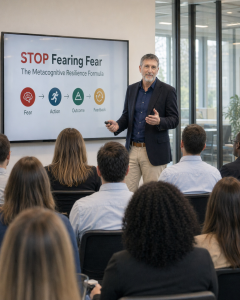
STOP Fearing Fear® gives staff, managers and leaders a practical behavioural framework for recognising what is happening earlier and responding before problems become embedded.
It helps people understand fear as essential data, not weakness, failure, drama or dysfunction. It explains how challenge, adversity, uncertainty, responsibility, change, conflict and consequence can be perceived as threat, and how that process can influence interpretation, feeling, action, outcome and feedback.
This is the route organisations often miss. They see the visible outcome, but not the behavioural process that created it.
Speaking and training develops behavioural understanding and Early Self-Intervention. It gives people a shared language for recognising how repeated strain can lead to avoidance or over-functioning, how ineffective responses can become embedded, and how negative feedback loops can increase exhaustion, conflict, disengagement and decline.
This work can sit alongside existing mental-health, wellbeing, leadership and staff-development provision. It provides a distinct preventive layer: practical behavioural education that helps people recognise the mechanism, interrupt it earlier and improve what happens next.
The missing layer is behaviour.
Burnout does not start at burnout. Absence does not start at absence. Breakdown does not start at breakdown.
These are often late-stage outcomes of a process that has already been building through repeated strain, unresolved fear responses, avoidance, ineffective action, poor recovery, negative feedback loops, unclear responsibility and unmet needs.
Long before the visible outcome, people may begin to hesitate, withdraw, over-function, delay decisions, avoid difficult conversations, become irritable, lose confidence, communicate poorly, disconnect or continue pushing until something gives.
These behaviours are often treated as attitude problems, performance problems, personality problems or isolated wellbeing concerns. Many are earlier signs of fear, strain, avoidance and unresolved behavioural loops.
If organisations want to prevent burnout, absence, conflict and disengagement earlier, they need to understand the behaviour before the visible outcome.
Behaviour Before Burnout.
Behaviour Before Burnout is the core STOP Fearing Fear® speaking and training programme for organisations that want to move prevention further upstream.
It is designed for leaders, managers, teams and staff groups who need a practical way to recognise what happens before stress becomes sickness, fear becomes avoidance, disengagement becomes absence and burnout becomes the headline problem.
The programme introduces the Behaviour Cycle and explains how perceived threat can influence interpretation, physical and emotional response, judgement, communication, decision-making and action. Participants learn to recognise earlier behavioural signs such as withdrawal, hesitation, over-functioning, irritability, avoidance, reduced confidence, poor recovery and repeated ineffective responses.
This is not another general wellbeing talk. It is structured behavioural education that helps people understand how unresolved cycles can stack, how individual behaviour interacts with organisational conditions and how earlier recognition can create opportunities for better action.
Behaviour Before Burnout develops behavioural understanding and Early Self-Intervention. It gives people a practical language for recognising fear and strain without treating every difficulty as illness, while helping managers and organisations identify emerging problems before they become harder and more costly to reverse.
The programme can be delivered as a 90-minute talk with questions and discussion, a workshop or a more detailed half-day session. Content can be shaped around the audience, organisational setting and intended outcomes.
➤ Discuss Behaviour Before Burnout
Behaviour and Fear Literacy for Schools and Care Settings.
Behaviour and Fear Literacy for Schools and Care Settings is the STOP Fearing Fear® speaking and training programme for schools, colleges, children’s homes, care settings, children’s services and professionals responsible for young people.
It is designed for educators, carers, social workers, support staff, leaders and other responsible adults who need a practical way to understand behaviour before it escalates.
Schools and care settings do not need every member of staff to become a therapist. They need staff to understand the basic mechanics of fear, behaviour and escalation, together with a shared language that can be used consistently across the adults and settings surrounding a young person.
The programme introduces the Behaviour Cycle and explains how perceived threat, fear, appraisal, feeling, action, outcome and feedback interact. It helps participants look beneath visible behaviour, recognise earlier signs of escalation and understand how ineffective responses can reinforce the very patterns they are intended to stop.
Participants are also introduced to the 7 Needs of Fulfilment®, the MetaSTOP Method® and the progression from supported intervention towards Early Self-Intervention. The aim is to help adults respond more accurately while gradually strengthening the young person’s own behavioural understanding and capability for Early Self-Intervention.
This is not therapy training or another isolated wellbeing initiative. It is practical behavioural education designed to strengthen consistency, reduce avoidable escalation and create a shared behavioural language across education, care, children’s services and home.
The programme can be delivered as an introductory talk, workshop or more structured staff-training session. Further input can be discussed for organisations interested in embedding the shared language more consistently across their setting.
Why this matters now.
Mental health and behavioural prevention are no longer just wellbeing concerns.
For workplaces, they affect leadership, workforce stability, retention, productivity, decision-making, safeguarding and operational risk. In schools and care settings, they affect behaviour, escalation, learning, relationships, attendance and the ability of adults to respond consistently around a young person.
Reactive support still matters. Counselling signposting, occupational health, mental health first aid, HR support, specialist services and crisis pathways all have their place.
But these routes often become active after distress, disengagement, absence or escalation is already visible. They do not automatically develop earlier recognition, behavioural understanding, Early Self-Intervention or a shared behavioural language.
That is the preventive layer STOP Fearing Fear® provides: helping people recognise fear and strain earlier, understand how they are influencing behaviour and respond before avoidable difficulty becomes embedded, costly or crisis-led.
The moral and operational question is simple.
If people often show signs before they break, why wait until the damage is visible before acting?
Behaviour Before Burnout helps organisations answer that question with something practical.
- Not another awareness session.
- Not another “be more resilient” talk.
- Not another tick-box wellbeing exercise.
A clear behavioural framework that helps people see what is happening earlier and act before the pattern becomes embedded.
Who this is for.
STOP Fearing Fear® Speaking & Training is designed for organisations and professional groups where behaviour, judgement, communication and response have real consequences.
Behaviour Before Burnout is relevant for employers, leadership teams, HR and people-development teams, managers, frontline services, public-facing organisations, small businesses, charities and professional groups. It is particularly valuable where organisations are dealing with stress, staff strain, low morale, conflict, disengagement, decision fatigue, reduced ownership, absence or burnout, or want to strengthen prevention before these problems become embedded.
Behaviour and Fear Literacy Training is designed for schools, colleges, children’s homes, care settings, children’s services, social-care teams, social workers and other professionals responsible for young people. It is especially relevant where adults need a clearer understanding of behaviour, fear and escalation, together with a shared behavioural language that can be used consistently across settings.
Sessions can also be adapted for conferences, staff-development days, leadership events, wellbeing events, emergency-service contexts, community organisations and other groups working with sustained challenge, responsibility or consequence.
The work is equally relevant for organisations that already provide reactive support but recognise that support after people are already struggling is not enough.
What the programmes cover.
Sessions are adapted to the organisation, setting and audience, but both programmes are grounded in the core STOP Fearing Fear® framework.
Shared themes can include fear as essential data, the Behaviour Cycle, perceived threat, pre-cognitive fear, appraisal, feeling, action, outcome and feedback. Participants learn how unresolved loops can repeat and stack, how behaviour provides earlier warning signs and how more effective responses can interrupt patterns before they become embedded.
Behaviour Before Burnout can cover avoidance, withdrawal, over-functioning, irritability, perfectionism, cynicism, poor communication, decision delay, emotional reactivity, conflict, reduced confidence and disengagement. It helps people understand how stress and burnout develop behaviourally, how managers can recognise earlier signs without becoming therapists and how teams can build a shared language around responsibility, action and prevention.
Behaviour and Fear Literacy Training can cover escalation, unmet needs, the 7 Needs of Fulfilment®, the MetaSTOP Method® and the progression from supported intervention towards Early Self-Intervention. It helps adults look beneath visible behaviour, respond more consistently and strengthen shared behavioural understanding across schools, care settings, children’s services and home.
Available formats.
Introductory talk or keynote
A strong introduction for conferences, leadership events, staff events, professional gatherings, away days and prevention-focused awareness events.
The content can be built around either Behaviour Before Burnout or Behaviour and Fear Literacy for Schools and Care Settings, introducing the relevant preventive argument, behavioural mechanisms and opportunities for earlier action.
Half-day training
A practical session for staff, managers, teams or mixed professional groups.
Depending on the programme, participants can develop a working understanding of the Behaviour Cycle, fear as essential data, perceived threat, early behavioural warning signs, avoidance, escalation, behavioural understanding and earlier intervention.
Full-day training
A deeper session for organisations and settings that want more detailed application.
This can include group discussion, relevant workplace or care-setting scenarios, behavioural warning-sign mapping, Behaviour Cycle mapping, MetaSTOP Method® application, team exercises and practical action planning.
Manager-focused session
A focused Behaviour Before Burnout session for leaders and managers who need to recognise and respond to earlier behavioural indicators without moving into clinical territory or trying to become counsellors.
Managers are not therapists. But they are often among the first people able to notice changes in behaviour, communication, performance, confidence, judgement, decision-making and engagement.
This session helps managers notice earlier, ask better questions, respond more usefully and avoid waiting until difficulty becomes absence, burnout or crisis.
Team-focused session
A practical Behaviour Before Burnout session for teams experiencing shared strain, communication difficulties, conflict, role confusion, avoidance, disengagement, unclear responsibility or repeated patterns affecting performance and morale.
It helps teams develop shared behavioural understanding without defaulting to blame, defensiveness or silence.
Schools and care-settings session
A focused Behaviour and Fear Literacy session for schools, colleges, children’s homes, care settings, children’s services and professionals responsible for young people.
It helps adults understand fear, behaviour and escalation; look beneath visible behaviour; respond more consistently; and begin developing a shared behavioural language across the people and settings surrounding a young person.
Bespoke speaking and training.
Behaviour Before Burnout and Behaviour and Fear Literacy for Schools and Care Settings are the two core speaking and training programmes.
Sessions can be adapted around the audience, setting and intended outcomes. Bespoke talks and training can also be developed around relevant STOP Fearing Fear® themes, including fear and behaviour, resilience before escalation, decision-making when faced with real-time challenge and adversity, communication and conflict, responsibility and response, behaviour before crisis, prevention before breakdown and practical metacognitive resilience.
For schools, care settings and children’s services, content can focus more specifically on behaviour, fear, escalation, unmet needs, supported intervention, Early Self-Intervention and developing a shared behavioural language across the adults and settings surrounding young people.
Bespoke content can be shaped for conferences, leadership events, staff-development days, professional groups, frontline services, education and care settings, and organisations looking for something more practical and substantial than generic wellbeing content.
What changes after the session?
- Participants gain a clearer understanding of how fear, perceived threat, repeated strain, unmet needs and ineffective responses can influence behaviour before bigger problems appear.
- Managers, leaders, educators, carers and other responsible adults gain a practical behavioural lens for noticing earlier signs, asking better questions and supporting more effective action without diagnosing people or trying to become therapists.
- Teams and settings gain a shared language around fear, behaviour, responsibility, escalation, challenge, adversity and prevention. This makes difficult patterns easier to recognise and discuss without defaulting to blame, avoidance or confusion.
- Workplaces strengthen their prevention layer by recognising behavioural strain before it becomes embedded as conflict, disengagement, absence or burnout.
- Schools, care settings and children’s services strengthen consistency across the adults surrounding young people, supporting earlier intervention and the gradual development of behavioural understanding and Early Self-Intervention.
What makes this different?
STOP Fearing Fear® does not treat burnout, absence, breakdown or behavioural escalation as the starting point. It treats them as later-stage outcomes of processes that have often been developing for some time.
It does not tell people to simply be more positive, more resilient or more open about their feelings.
It does not turn managers, educators, carers or other responsible adults into therapists.
It does not pretend external conditions do not matter. Workload, poor systems, unclear roles, weak leadership, cultural strain, operational demand and poor communication all matter. In schools and care settings, environment, relationships, unmet needs, inconsistency, previous experience and the responses of surrounding adults also matter.
The programmes explain how people behaviourally process these conditions, how fear and perceived threat can affect what happens next, and how workplaces, schools and care settings can recognise and respond earlier.
That is the difference: practical behavioural education that strengthens prevention before difficulty becomes embedded, escalates or reaches crisis.
Book a conversation
If your organisation or setting is still relying mainly on support after people are already stressed, absent, burned out, disengaged, struggling or escalating, it is time to move prevention further upstream.
STOP Fearing Fear® Speaking & Training provides two practical preventive routes.
Behaviour Before Burnout helps workplaces recognise the behavioural process earlier, before fear becomes avoidance, stress becomes absence and unresolved loops become organisational damage.
Behaviour and Fear Literacy for Schools and Care Settings helps educators, carers, children’s services and other professionals responsible for young people understand behaviour before it escalates and develop a shared behavioural language around fear, needs, intervention and response.
To discuss an introductory talk, keynote, workshop, half-day session, full-day training, manager or team session, schools and care-settings session, or bespoke programme, contact Paul to arrange an initial conversation.
➤ Enquire about speaking or training
Email: contact@stopfearingfear.com
➤ Explore the prevention resources
You can also read more about The Framework or The Book.
© 2026 Stop Fearing Fear Services Ltd. All rights reserved.
STOP Fearing Fear® and associated frameworks, terminology and diagrams are protected intellectual property.
Contact: contact@stopfearingfear.com