The STOP Fearing Fear® Framework
What does “earlier” actually look like?
People are routinely told to recognise problems earlier, manage pressure earlier, intervene earlier or ask for help earlier. But what ‘earlier’ actually means within our daily Behaviour Cycles is often left unclear.
STOP Fearing Fear® identifies the prevention window: when unresolved fear and pressure are beginning to affect appraisal, behaviour and decision-making, but before manageable difficulty becomes chronic strain, overwhelm, burnout, breakdown or harm.
By mapping the full Behaviour Cycle, the framework helps people notice what is changing, understand the process beneath it and decide what to do next—independently where possible or with appropriate support where needed.
This is how Early Self-Intervention becomes practical: people can recognise when “early” is.
➤ Start with the book
➤ See how this applies to you
A behavioural framework for prevention
STOP Fearing Fear® is an original, practice-developed and evidence-informed framework within Preventive Mental Health Education.
It develops Preventive Mental Health Capability through Metacognitive Intervention and practical Early Self-Intervention.
Its teaching engines are Behaviour, Fear and Resilience Education. Its operational mechanisms include the Behaviour Cycle, the Meta-Resilience Formula, MetaSTOP, STOP and GO.
You cannot intervene early in a problem you have never been taught to recognise. Metacognitive Intervention means noticing what is happening in thinking, feeling and behaviour; gaining perspective; interrupting the default response; considering options; choosing deliberate action; and learning from feedback—independently where possible or with appropriate support where needed.
Fear is not the enemy – but it is not harmless either
Fear is an ancient, pre-cognitive signal that something has changed and may carry a cost. Its purpose is protective: to capture attention and prepare the person to respond.
The threat system responds not only to physical danger, but also to social and emotional threats such as rejection, conflict, uncertainty, financial strain, loss of control or reputational exposure.
The response may be automatic, but what follows is not fixed. Fear can sharpen attention and support action, but when it is misread, avoided or left unresolved, it can narrow appraisal, distort behaviour and keep the cycle active.
Fear is data. It requires interpretation, not automatic obedience or automatic rejection.
How cycles remain unresolved
The cycle becomes damaging when the response does not adequately address the threat or resolve its effects.
Appraisal may become distorted, feeling intensifies and action becomes delayed, avoided, impulsive or absent. The outcome then worsens the situation or fails to produce useful corrective feedback.
When that feedback reinforces the same appraisal and response, the cycle loops. As unresolved cycles accumulate, stress can stack and previously manageable difficulty can become increasingly hard to interrupt.
The damage point is not fear on its own. It is fear remaining unresolved within a repeating behavioural process.
The Behaviour Cycle

At the centre of the framework is the Behaviour Cycle.
Behaviour is not simply the visible action at the end. It is the complete process through which a person encounters threat, interprets what is happening, responds and learns from what follows.
Change in Circumstance→ Threat Perception→ Pre-Cognitive Fear→ Appraisal (Memory)→ Feeling→ Action→ Outcome→ Feedback (Memory)
Each outcome creates feedback that influences future appraisal and response. When we focus only on the visible action, we miss both the mechanism driving it and the earlier points at which the cycle could be interrupted.
The Parallel Health Model
Prevention involves more than reducing risk and more than responding once difficulties have become severe. In both physical and mental health, people need practical capability to recognise warning signs, take appropriate early action and know when to seek additional support.
1. Maintain / reduce risk
Physical health
Diet, exercise, hygiene, protective habits and risk reduction.
Mental health
Wellbeing, healthy routine, relationships, lifestyle support and mental-health promotion.
2. Recognise / respond early
Physical health
Recognising warning signs, self-care, first aid, early action and knowing when to escalate.
Mental health
Self-help, literacy and early interventions exist; however, practical Early Self-Intervention capability—recognising developing behavioural processes and responding early—remains fragmented and inconsistently taught.
3. Treat / support
Physical health
Doctors, hospitals and specialist care.
Mental health
Therapy, counselling, psychiatry, medication, specialist care and crisis support.
STOP Fearing Fear® contributes to the middle layer by developing Preventive Mental Health Capability: the ability to recognise what fear, pressure or uncertainty are beginning to do to interpretation and behaviour, take more deliberate action, learn from feedback and seek further support when needed.
The Preventive Capability Gap
Mental-health provision exists across the spectrum, but practical early self-intervention is not yet a sufficiently coherent, widely understood and transferable public capability. STOP Fearing Fear® sits within the capability gap: an original, practice-developed and evidence-informed framework within Preventive Mental Health Education. It develops Preventive Mental Health Capability through Metacognitive Intervention and practical Early Self-Intervention. Preventive capability includes knowing what can be influenced independently, what may benefit from support, and when professional help should be sought.
Why action matters so much
Understanding creates the possibility of change, but action is where the Behaviour Cycle meets reality. Without action, there is no new outcome and no new feedback from which to learn.
More deliberate action does not guarantee the desired outcome. It increases the opportunity to influence what happens next and produces real feedback that can improve future appraisal and response.
Effective action is not reckless, avoidant or blindly positive. It is a more accurate and responsible response taken while the outcome can still be influenced.
Through action, outcome and feedback, understanding becomes practical and resilience is developed in real conditions.
Escalation and Overload
Deterioration can develop through two broad routes.
Escalation is a gradual build. Unresolved cycles loop and stack, stress becomes chronic, behaviour narrows and judgement deteriorates. Over time, the person may move towards overwhelm, burnout or breakdown.
Overload is different. A sudden event or major impact can push demands beyond the person’s immediate capacity and leave them struggling to regain stability.
One route accumulates; the other hits quickly. Both require earlier recognition, effective action and appropriate self-intervention or supported intervention.
➤ Explore the Burnout Resource Guides
What resilience really is
In this framework, resilience is not resistance, denial, avoidance or endless endurance.
Resilience is the skilled response applied once fear, challenge or adversity has already arrived. It does not remove difficulty or guarantee control of the outcome. It influences how accurately the situation is appraised, what action follows and how feedback is used.
Within a prevention framework, resilience is developed before it is needed and strengthened through application. The aim is not simply to endure more, but to respond earlier and reduce unnecessary deterioration.
Why metacognitive resilience matters
Metacognitive resilience is the learned ability to notice the Behaviour Cycle while it is happening, step back from automatic reaction and respond more deliberately.
It is not about becoming fearless or controlling every outcome. It develops the capacity for more accurate appraisal, more effective action and better use of feedback before an unresolved cycle becomes established.
Within STOP Fearing Fear®, metacognitive resilience is a learnable, trainable and transferable capability for influencing what happens next.
The Metacognitive Resilience Equation
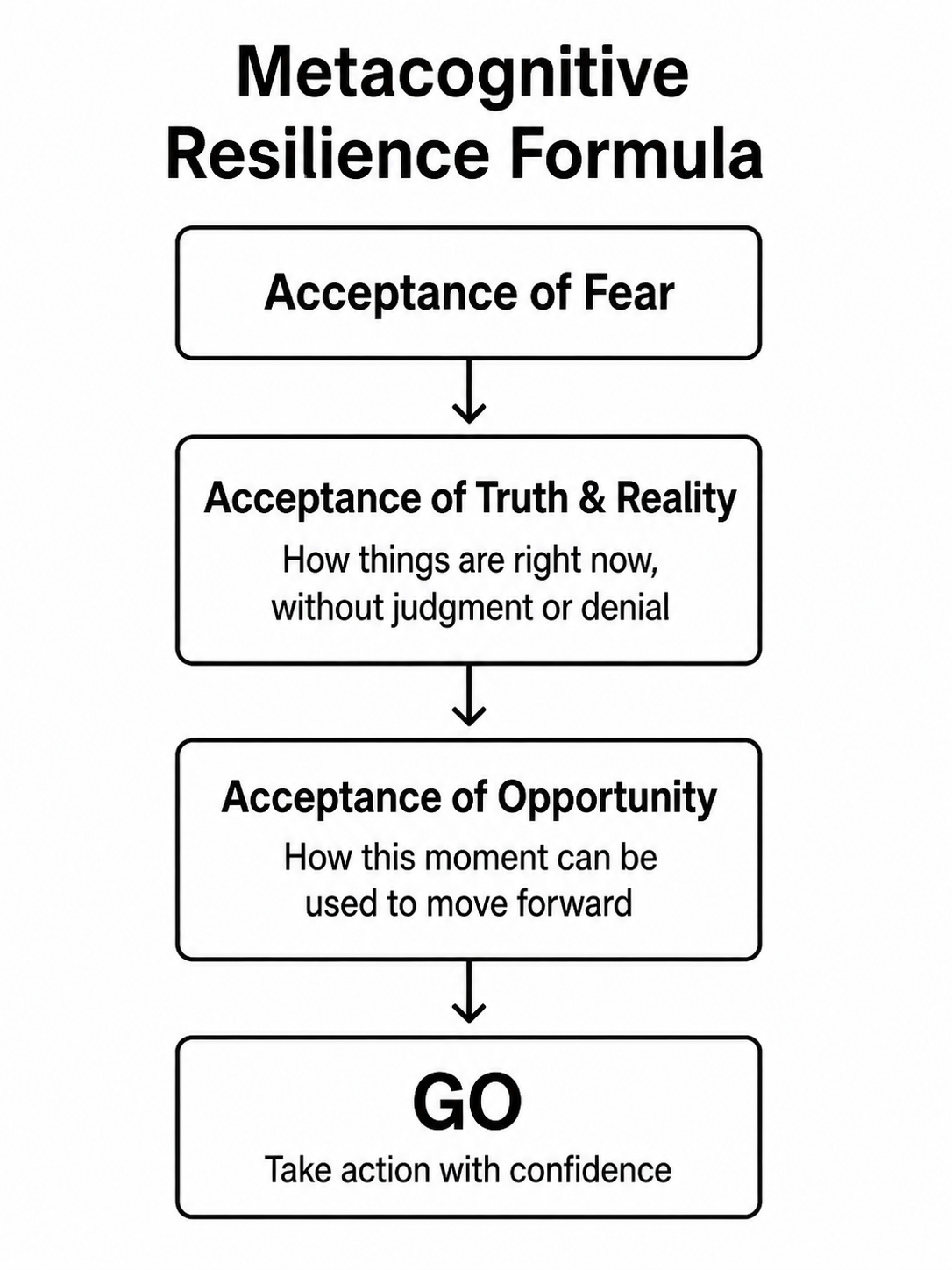
The Metacognitive Resilience Equation organises metacognitive resilience around three forms of acceptance:
MR = Af × Atr × Ao
- Af = Acceptance of Fear
- Atr = Acceptance of Truth & Reality
- Ao = Acceptance of Opportunity
The equation is multiplicative rather than additive because weakness in any one factor reduces the strength of the whole response.
Acceptance does not mean approval, passivity or resignation. It means acknowledging fear, facing the relevant truth and reality, and recognising the opportunity to act while the outcome can still be influenced.
The equation is a practical conceptual model, not a clinical diagnostic measure.
What the framework develops
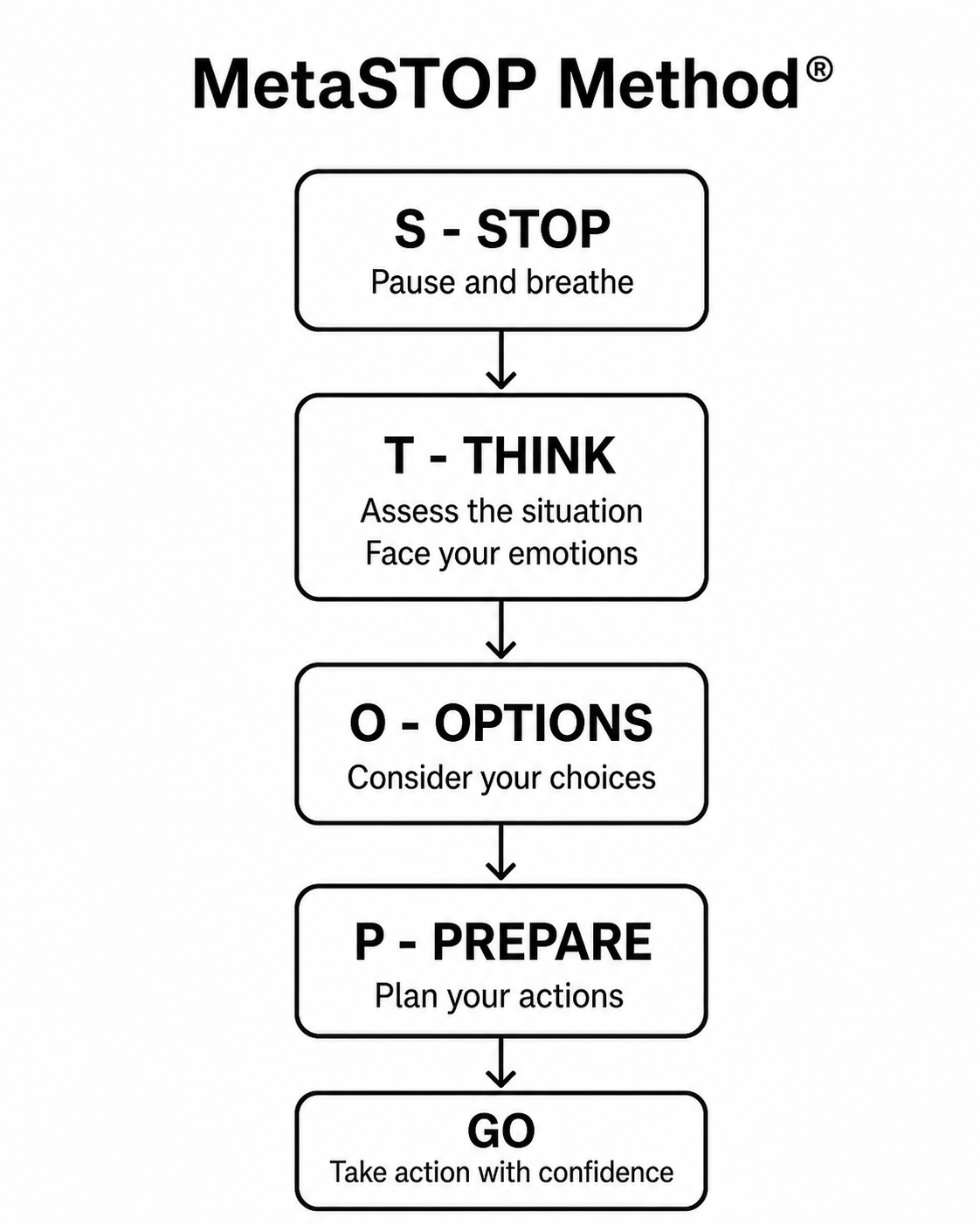
The framework is designed to develop the ability to recognise what is happening within behaviour and respond more deliberately.
It helps people:
- recognise fear and behavioural patterns earlier
- appraise threat, truth, reality and opportunity more accurately
- interrupt unresolved cycles through more effective action
- learn from outcomes and feedback
- strengthen future response and reduce unnecessary deterioration.
The MetaSTOP Method® provides a practical route through Stop, Think, Options and Prepare, followed by GO!. It turns earlier recognition into Early Self-Intervention by creating a structured pause between automatic reaction and deliberate action.
The framework can be applied through Early Self-Intervention or appropriate supported intervention wherever human behaviour, responsibility and outcomes matter.