Who Is STOP Fearing Fear® For?
When pressure is shaping your life, your decisions, or the people depending on you, this is for you.
This work is for people who know something deeper is going on.
You may be feeling the strain in your own life. You may be trying to support somebody close to you. You may be carrying responsibility for others at home, at work, or in a professional role where behaviour, pressure, and judgement matter.
Whatever brought you here, the core problem is often similar. Fear alters behaviour. Pressure narrows response. People get stuck in loops of thought and feeling without moving through to effective action, outcome, and feedback. That is where stress starts to stack, patterns start to repeat, and unnecessary deterioration begins.
STOP Fearing Fear® is for people who want something clearer, more practical, and more useful than vague reassurance, surface-level wellbeing language, or explanation without direction.
If you are struggling in your own life
This work is for you if life looks functional on the outside but feels harder to manage underneath.
You may be dealing with stress, hesitation, avoidance, overwhelm, poor decisions, repeated patterns, emotional strain, or the sense that you are carrying more than you are resolving. You may understand some of what is happening already, but still not have a clear way to make sense of fear, behaviour, resilience, and what needs to change.
This book and framework are designed to help you understand the mechanism underneath pressure, then move beyond getting stuck in thoughts and feelings alone. The aim is not just insight. It is better action, better outcomes, and better feedback in real life.
If somebody depends on you personally
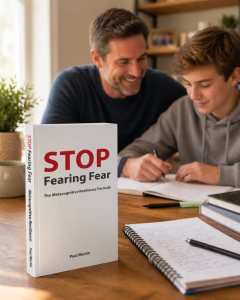
This work is for you if you are trying to support somebody you care about and want a better way to understand what is happening underneath the surface.
That might be your child, your partner, a family member, or a friend. You may be watching them struggle with withdrawal, overwhelm, avoidance, reactivity, conflict, poor choices, or repeated patterns that do not seem to shift. You may want to help, but feel unsure whether you are looking at stress, fear, behaviour, vulnerability, or something else entirely.
This work helps you look beneath visible behaviour and understand the wider process. It gives you a clearer way to make sense of what strain and unresolved fear do to people, how fear affects response, and why support needs to be steadier, more accurate, and more action-oriented if it is going to help.
If you carry professional responsibility
This work is for you if other people rely on your clarity, judgement, and steadiness under pressure.
You may be a leader, manager, educator, practitioner, founder, intervention worker, or somebody making decisions that affect other people. You may be dealing with staff strain, inconsistent behaviour, poor judgement under pressure, conflict, avoidance, overload, or people who look capable until suddenly they are not.
In that kind of role, it is not enough to react to visible fallout once the damage is already underway. You need a clearer way to understand what pressure is doing to behaviour, how fear alters judgement and response, and why people get stuck without moving toward better action, outcome, and feedback.
This work is built for real-world settings where responsibility is high, behaviour matters, and weak explanations are not enough.
If you work in behaviour, support, crisis, or high-pressure environments
This work is for you if behaviour is part of your professional world and the consequences are real.
You may work in education, SEND, care, safeguarding, alternative provision, intervention, crisis services, emergency settings, support roles, or other environments where people are escalated, shut down, overloaded, oppositional, reactive, avoidant, or stuck in repeated patterns. You may also know what it is like to carry that pressure yourself while trying to stay effective.
This work offers something more joined-up than vague theory and more practical than surface-level language. It treats behaviour as a full process, not just an action at the end. It connects fear, pressure, action, outcomes, and resilience in a way that helps people understand what is happening more clearly and respond more effectively.
In simple terms
This work is for you if you want to:
- understand behaviour more deeply
- understand fear more accurately
- make better decisions under pressure
- stop getting stuck in unhelpful loops
- take more effective action sooner
- create better outcomes and better feedback
- build stronger resilience in real life
- understand yourself and others more clearly
Whether your concern is personal, relational, professional, or organisational, the core aim is the same: understand the mechanism better, respond better, and stop letting unresolved pressure keep repeating the pattern.
Start where it fits
If you want the full explanation of the model and the route into stronger action under pressure, start with the book.
If you want to understand how the model works, explore the framework.
If you want to bring this into a team, service, school, organisation, or professional setting, start with the services.
➤ Buy the Book
➤ Explore the Framework
➤ Bring This Into Your Life or Organisation
STOP Fearing Fear® is designed to help you understand the mechanism, not just the mood. It gives you a clearer way to understand what is happening, why it is happening, and how to respond more effectively, whether the pressure is personal, relational, professional, or organisational.