Preventive Mental Health Education
Fear, pressure and uncertainty can begin shaping thinking, decisions and behaviour long before a problem becomes obvious.
STOP Fearing Fear® develops Preventive Mental Health Capability: practical recognition and response skills that help people notice what is changing, interrupt unhelpful default reactions and act while meaningful options remain.
It provides a practical behavioural framework for understanding the Behaviour Cycle and deciding what to do next—independently where possible or with appropriate support where needed.
Metacognitive Intervention is the process: recognise what is happening, gain perspective, consider realistic options and choose a more effective action.
Early Self-Intervention is the practical route—turning prevention from vague advice into a capability people can learn and use.
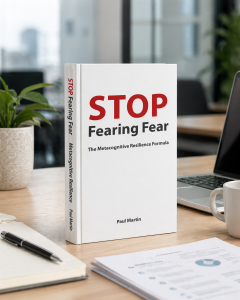
STOP Fearing Fear®
The Metacognitive Resilience Formula
The book introduces the behavioural framework for recognising fear-driven behaviour, interrupting escalation and intervening earlier.
The capability gap
Wellbeing support and risk reduction help people maintain capacity. Therapy, counselling, clinical treatment and crisis support are valuable when they are needed. Prevention also depends on practical early recognition and response: knowing what to look for, what action is appropriate and when to seek further support.
Mental-health provision exists across the spectrum, but practical early self-intervention is not yet a sufficiently coherent, widely understood and transferable public capability. STOP Fearing Fear® works within that capability gap.
You cannot intervene early in a problem you have never been taught to recognise.
Fear sits underneath more than you think
Difficulties rarely begin at the point at which they become visible. When fear reactions to external pressures are poorly resolved, Behaviour Cycles can repeat, pressures and consequences can accumulate, and judgement, behaviour, capacity and recovery can deteriorate. Less effective decisions, actions and outcomes then feed back into the cycle, making it easier to repeat.
STOP Fearing Fear® develops Preventive Mental Health Capability: the practical ability to recognise what is happening, understand the behaviour fear is shaping, consider realistic options and act before avoidable difficulties escalate.
Early Self-Intervention is prevention applied in real time. It builds people’s capacity to act earlier for themselves, with appropriate support where needed.
Different challenges – Same internal process

Challenge may come through relationships, family, health, work, money, responsibility, uncertainty or the effort to rebuild direction. The circumstances change, but the behavioural process underneath them is often the same.
The Behaviour Cycle maps that process:
A Change in Circumstance → Threat Perception → Pre-Cognitive Fear → Appraisal (Memory) → Feeling → Action → Outcome → Feedback (Memory)
Once that process can be recognised, it can be interrupted earlier. This is what makes prevention teachable and Early Self-Intervention practical across personal life, education, care, leadership and work.
When Behaviour Cycles repeat
Fear reactions do not simply disappear when a response fails to resolve the perceived threat. The outcome feeds back into memory, making the Behaviour Cycle increasingly easy to repeat.
Repeated cycles can surface as overthinking, hesitation, irritability, dread, procrastination, emotional flatness, withdrawal, conflict, exhaustion, avoidance or poor decision-making, together with a growing sense that life is becoming harder to manage.
These are often treated as separate problems after they become visible. STOP Fearing Fear® teaches people to recognise the repeating cycle earlier, interrupt the behaviour fear is shaping and improve what happens next.
Before the headline problem appears
Burnout is not the first event. Neither are entrenched avoidance, damaged relationships, repeated conflict, poor judgement or breakdown. Before the headline problem appears, changes in thinking, behaviour, decision-making and response are usually already visible.
The prevention opportunity exists between that first change and the later crisis. STOP Fearing Fear® helps individuals and organisations recognise the process earlier and act while more options remain available.
Preventive capability has to become a stronger part of our mental health culture, alongside support and care.
The problem is not fear
Fear is a signal: an essential pre-cognitive response to perceived change, uncertainty or threat. It is not the enemy, and the aim is not to eliminate it. Problems develop when fear is misunderstood or amplified, or when fear reactions are avoided or repeatedly left unresolved.
During real-time challenge, fear can narrow attention, distort judgement, trigger defensive behaviour and pull people away from the action most likely to improve the outcome.
Recognising the signal, interpreting the situation more accurately and choosing a more effective response builds the capacity to act well when fear is present. The aim is not fearlessness. It is better behaviour, better decisions and better outcomes.
A practical framework for preventive capability
STOP Fearing Fear® turns prevention from a broad intention into Preventive Mental Health Capability: a structured behavioural capability that can be taught, practised, applied and assessed.
Through Behaviour, Fear and Resilience Education, people learn to recognise what is happening, understand how fear is shaping behaviour, interrupt unhelpful default responses, consider realistic options, take more effective action and use the outcome as feedback.
Metacognitive Intervention is the process that supports this shift. Early Self-Intervention puts the capability into practice, helping people respond earlier before repeated difficulty becomes an embedded problem.
Built through crisis intervention – Applied before crisis
STOP Fearing Fear® was developed ground-up through complex lived adversity and more than 25 years of professional experience across specialist behavioural education, psychiatric settings, emergency residential crisis care, family crisis work, one-to-one intervention, outdoor intervention and high-pressure leadership.
It came from situations in which fear, behaviour and decisions carry real consequences, where people need something clear, usable and immediate.
The behavioural patterns seen during crisis are often present long before crisis occurs. STOP Fearing Fear® brings that knowledge forward, turning frontline experience into practical prevention education that can be applied earlier in personal life, relationships, education, care, leadership and work.
The core shift: from awareness to earlier action
Awareness and wellbeing practices matter, but awareness alone does not change the Behaviour Cycle. People also need to know what to look for, how to recognise developing behavioural patterns, what action is appropriate and when additional support is needed.
STOP Fearing Fear® moves people from noticing a problem to intervening in the process producing it: recognise fear earlier, gain perspective, interrupt the default response, consider realistic options, take more effective action and learn from the outcome. Seeking professional help early can itself be a preventive action.
Prevention is not the absence of action. It is earlier, more capable action.
Explore the prevention framework
The STOP Fearing Fear® framework brings together the Behaviour Cycle, Metacognitive Resilience Formula and MetaSTOP Method® within one practical, teachable system.
It explains the full Behaviour Cycle from Change in Circumstance through Threat Perception, Pre-Cognitive Fear, Appraisal (Memory), Feeling, Action, Outcome and Feedback (Memory), then identifies where earlier recognition and Early Self-Intervention can change what happens next.
This framework provides the underlying structure for the book, resources, personal work, speaking and organisational training.
Start with the book
STOP Fearing Fear®: The Metacognitive Resilience Formula is the clearest introduction to the behavioural framework and the prevention model behind it.
The book explains why fear is more than something people feel. It influences interpretation, behaviour, decisions, relationships, stress, burnout, resilience and the outcomes that follow.
Part One explains why fear appears, how the Behaviour Cycle operates and how unresolved or poorly resolved fear reactions can feed repeating Behaviour Cycles, contributing to avoidance, overwhelm, conflict and breakdown.
Part Two introduces metacognitive resilience and the MetaSTOP Method®, providing a practical structure for interrupting the loop, taking clearer action and learning from the outcome.
Together, these ideas provide a practical foundation for behavioural self-recognition, clearer decisions and Early Self-Intervention.
Who this is for
STOP Fearing Fear® is not limited to people already in crisis. Its greatest preventive value often comes earlier, when someone can see that stress, avoidance, conflict, overwhelm, poor decisions or repeated behavioural patterns are beginning to affect what happens next.
It is for individuals who want to understand their own behaviour, respond more effectively during challenge and develop a capability they can continue using independently.
It is also for parents, carers, educators, frontline workers, professionals, leaders, teams and organisations that carry responsibility for other people and need a clearer shared language for recognising behaviour and intervening before problems escalate.
Different settings create different challenges. The common requirement is earlier recognition, clearer thinking and more effective action.
Services
STOP Fearing Fear® is delivered through focused individual work, organisational education and applied group development. Each route uses the same behavioural framework but responds to a different need: immediate intervention, forward development, preventive education or group capability.
Personal Intervention
For people dealing with something current, pressing or beginning to cause wider damage.
Personal Intervention is focused one-to-one work around an active difficulty, behavioural loop, decision, conflict or period of strain. Its immediate purpose is damage limitation: reduce escalation, restore clarity, identify a useful next action and return the person to forward momentum.
The present situation is then used to strengthen behavioural self-recognition and Early Self-Intervention for the future. It is focused, practical work, not open-ended therapy, and is available online or through suitable Walk & Talk sessions in Derbyshire and surrounding areas.
Suitable Walk & Talk sessions are professionally led by Paul Martin, a qualified Mountain Leader, Climbing Instructor and REC Outdoor First Aid trained outdoor-intervention practitioner.
➤ Explore Personal Intervention
➤ Explore Walk & Talk in Derbyshire
Personal Coaching
For people who are functioning, but want to function more clearly, deliberately and effectively.
Personal Coaching is an individualised four-session programme built from the same Behaviour, Fear and Resilience Education delivered through speaking and training. It applies the framework directly to the person’s decisions, responsibilities, recurring patterns and future direction.
The aim is to strengthen behavioural self-recognition and Early Self-Intervention, giving people a practical capability they can continue using independently.
Speaking & Training
For organisations that want prevention to become part of their culture, not something considered only after problems become visible.
Speaking and training bring practical Behaviour, Fear and Resilience Education into workplaces, education, care and other responsibility-led settings. Sessions help people recognise fear-driven behaviour and escalation earlier, improve judgement during challenge and act before stress, conflict, disengagement, poor decisions or burnout become embedded.
This is preventive mental health education made practical, teachable and relevant to real organisational behaviour.
Group Development Days
For organisations that want more than enjoyable team-building that is quickly forgotten.
Group Development Days use structured challenge, observation, reflection and targeted teaching to bring real behaviour into view. They develop communication, interpersonal awareness, decision-making, problem-solving and strategic thinking while challenge is actually taking place.
The result is applied behavioural learning that teams can carry back into everyday working relationships, responsibilities and decisions.
About Paul Martin
Paul Martin is the author of STOP Fearing Fear®: The Metacognitive Resilience Formula and the creator of the wider STOP Fearing Fear® behavioural prevention framework. He works as an intervention specialist, educator and speaker.
His work draws upon complex lived experience and more than 25 years across specialist behavioural education, psychiatric settings, emergency residential crisis care, family crisis work, one-to-one intervention, adult coaching, outdoor intervention and remote outdoor leadership.
Paul now applies that experience to preventive mental health education, helping individuals and organisations recognise behavioural processes earlier, make clearer decisions under pressure and intervene before avoidable difficulties escalate.
You do not need more vague awareness
Awareness without usable action leaves the Behaviour Cycle unchanged. People need to understand what fear is doing, recognise the behaviour it is shaping and know how to respond while meaningful options are still available.
STOP Fearing Fear® provides a practical route from recognition to action. It helps individuals and organisations recognise behavioural patterns, intervene earlier and improve the outcomes that follow.
Whether you need immediate Personal Intervention, structured coaching, organisational speaking and training, or a place to begin independently, choose the route that fits what you need now.
Recognise what is happening. Intervene earlier. Improve what happens next.
© 2026 Stop Fearing Fear Services Ltd. All rights reserved.
STOP Fearing Fear® and associated frameworks, terminology and diagrams are protected intellectual property.
Contact: contact@stopfearingfear.com